Performance Notes of Intercross#2 by Wahyu Ramadhan
Approaching the end of 2022, the Ethnomusicology Department of ISI Yogyakarta held an ethnic music performance entitled Saling-silang #2. The content and context of this performance is the crossing of musical cultures in the form of arrangements of ethnic or regional songs in the archipelago. Saling-silang #2 was held for two days on December 12-13, 2022 at the mini concert of the Department of Ethnomusicology ISI Yogyakarta. This performance was able to spoil the eyes and ears of the audience. Just imagine, regional songs A are presented with musical styles from region B, with differences in musical instruments, scales, dynamics, playing patterns, and so on. Perhaps for some of the audience present or ordinary people who listen, they may not know that the original song that has been performed by the presenter has been changed or is not in accordance with the original song. For example, the song Bangbung Hideung from West Java, arranged by Wahyu Ramadhan and Nurul Azmi. The song Bangbung Hideung which is thick with pentatonic nuances with typical Sundanese cengkok is changed into the Panting musical style typical of the Banjar ethnicity of South Kalimantan.
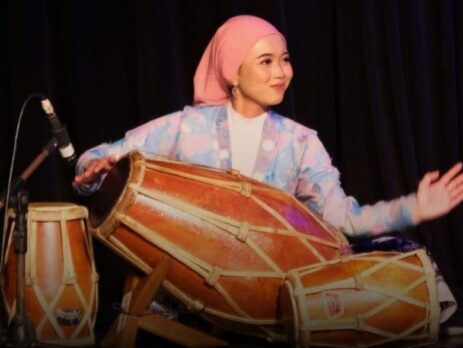
Behind the musical repertoires presented, there is one interesting phenomenon that we can see, namely the presence of a female rider. The rider is Amina Raiska, a student of the Department of Ethnomusicology ISI Jogja class of 2020. Her friends call her by her nickname, Icha. The girl from Jakarta has studied and pursued drumming since she was in middle school. On that night, Icha played her drums so smoothly that the audience was amazed. Based on the narrative of one of the spectators (did not want to be named), said “really cool kak icha, I thought it would be different from male drummers, but it turned out to be the same, even a plus for kak Icha in the eyes of guys”
Looking dashing and graceful was the initial impression I got. A woman in a Malay dress was beating the Sundanese drum at a performance held at the Ethnomusicology Department of ISI Yogyakarta. Don't get me wrong, the Sundanese kendang, which is synonymous with being played by men who need big hand muscles, is now being played by a woman. To me, the phenomenon seemed unfamiliar, and perhaps to most of the audience, the majority of whom were young people who attended the event.

In this case, I as an art student who was learning to see the phenomena of traditional music culture in Indonesia wondered whether it was really permissible for a woman to play the drum, could the power of her hand be as strong as a man's hand? This eventually led my opinion to the issue of gender equality, especially in traditional music culture. Gender equality is generally understood between men and women have the same position in enjoying every right of life, which distinguishes between these two creatures of God is that men cannot breastfeed and also give birth. In this phenomenon, the Sundanese Kendang instrument in traditional music culture in West Java is generally played by a man. Perhaps, if played by women there are boundaries of social/religious norms that are violated, or indeed Sundanese kendang requires large hand muscles that tend to be owned by men. On that night, Icha appeared to play Sundanese drums powerfully. The stigma of male “power” was broken through the phenomenon of Icha the female drummer. The audience cheered loudly when Icha played a Sundanese drum solo in the arrangement of the song Dodoi Si Dodoi with Javanese-Betawi nuances worked on with Anggy Caesarano.
Seeing the response of the audience who cheered in watching Icha's performance, emphasized that Icha seemed to be one of the stars in the show that night. This also emphasizes that every human being has the right to express his life. In this context, art can be an effective campaign medium for gender equality issues. anyone can play the drums, as long as he is able to why not. On the other hand, it can be a selling point.self branding for herself. Of course, Icha must feel proud of her skills because her abilities can be aligned with those of male riders. Like the moon at night that shines brighter among the stars.
Author: Wahyu Ramadhan, Student of Ethnomusicology Department ISI Yogyakarta Class of 2020
Editor: Ribeth Nurvijayanto