By: Denny Bhagus Syahroni
Glipang Rodhat History at a Glance
Lumajang is one of the districts in East Java Province of the former Besuki Karesidenan, which is often called the Pandhalungan region, an area of cultural acculturation between the two dominant cultures in the horseshoe region, namely Timuran Javanese culture and Madurese culture (Sutarto, 2006: 1). Customs in the horseshoe region are heavily influenced by Madurese culture and Islam. This has influenced the arts that have developed in the region, which are generally agrarian and religious (Islamic) art products. The potential of the arts that developed in Lumajang Regency is very diverse, but not a few have also experienced extinction.
One of the traditional arts in Lumajang that still survives today is Glipang Rodhat. Glipang Rodhat is a type of performance that features unique dance movements accompanied by typical Islamic music (Hariyati, 2016: 3). Glipang Rodhat grew and developed not only in Lumajang Regency, but also in Probolinggo Regency. This is not surprising, as both are located in the same region, Pandhalungan (Hariyati, 2016: 3).
At present, several villages in Lumajang still maintain the Glipang Rodhat art, one of which is Nguter Village. Historically, Glipang Rodhat is a performance art formed from a combination of two different arts, namely Glipang art and Rodhat Dance (Hariyati, 2016: 13). Glipang art was born in a pesantren environment, so it is not surprising that this art is closely related to Islam. The history of its formation also has various versions. The reality in the field shows that Glipang art developed not only in one region or district, such as in Lumajang Regency, but also in other districts, one of which is in Probolinggo Regency (Hariyati, 2016: 3). The various versions of Glipang art in substance are basically not much different from one another, namely the background of indigenous resistance to Dutch colonialism.
On the other hand, Rodhat Dance is an art that originated from a martial art accompanied by hadrah music from Turkey. Over time, a person named Sardi wanted to initiate a new art by combining Rodhat Dance with a similar art that had existed before, namely Glipang art. The result of the merger was called Glipang Rodhat art (Hariyati, 2016: 3).
Interpreting Symbols in Glipang Rodhat
This paper will discuss the Islamic symbols presented in the Glipang Rodhat art in Nguter Village, Pasirian District, Lumajang Regency, East Java.
1. Music
The music in Glipang Rodhat acts as a dance accompaniment. The combination of local Javanese nuances with Islamic nuances in Glipang Rodhat dance accompaniment music makes it unique and interesting, until it finally becomes one of the distinctive characteristics of Glipang Rodhat.
a. Instrument
1) Fly
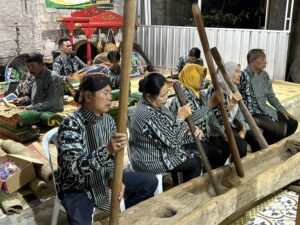
Terbang or also called tambourine is a musical instrument that is identical as an accompaniment in Islamic arts, such as hadrah, barzanji, kuntulan, and so on (Wuryansari and Purwaningsih, 2017: 78). There are five pieces of flying in Glipang Rodhat art. The division of the flying game pattern is divided into 3, namely fly 1 plays a pattern of siji (one), fly 2 and 3 play patterns loro (two), and flies 4 and 5 play patterns telu (three) of which the three are playfully referred to as isen-isenan or complementary.
Symbolically, the use of five flies is a symbol of the pillars of Islam consisting of the creed, prayer, fasting, zakat, and hajj. In addition to being a symbol of the pillars of Islam, it is also a symbol of the 5 daily prayers consisting of the Fajr prayer, Zuhur prayer, Asar prayer, Maghrib prayer, and Isha prayer. Related to the number 5 in the use of flying instruments is intended as a reminder addressed to Muslims to always remember their obligations as Muslims. While the pattern of play that fills each other or isen-isenan is a symbol or symbolization of human life that complements each other or gets along well.
2) Ketipung lanang and ketipung wedok
Dance accompaniment music in Glipang Rodhat art uses a distinctive instrument called ketipung lanang and ketipung wedok. This pair of instruments in its presentation as dance accompaniment has their respective roles. Ketipung lanang acts as a rhythm regulator, while ketipung wedok fills in the empty parts of the ketipung lanang game. In addition, this pair of instruments also marks the beginning of a Glipang Rodhat art performance.
The pair of ketipung lanang and wedok is a symbol or symbolization of a pair of men and women as stipulated by Allah SWT, that humans actually live in pairs, namely men and women. Related to the pattern of the game is a symbol that in life men are leaders who organize everything, while women are the ones who complete it.
3) Jidor
Jidor is an instrument that has a shape like a drum with a circle diameter of 60 cm and a length of 60 cm. Jidor in Glipang Rodhat art is only one instrument. The character of the sound that tends to be loud and heavy makes this instrument play a role in emphasizing the rhythm. Jidor, which is only one piece, symbolizes the majesty of God Almighty. Its role to emphasize the rhythm is also related to the majesty of Allah SWT in Islam. In addition, the jidor with the largest instrument shape among other instruments is a symbol that human life and life is from and the impression is the foundation of human life.
b. Vowels
In addition to musical instruments, the Glipang Rodhat art in its presentation also uses vocals in the form of chanting Awayaro songs. The lyrics use a mixture of Arabic and Javanese. The use of language in the lyrics of the Awayaro song is different from one region to another. If it is in the Madura area, then the language used is Madurese. While the performance in the Java area, the language used is Javanese. The scales for the vocals used are pentatonic slendro tones consisting of 1-2-3-5-6 (do-re-mi-sol-la), accompanied by the percussion instruments mentioned earlier. The tembang that serves as dance accompaniment has lyrics that cannot be interpreted word-for-word and can only be understood by linking the entire line of lyrics. The lyrics of the Awayaro tembang have actually changed in its development, especially in the pronunciation of the lyrics, which makes the original or actual words increasingly difficult to know. Supriyatin (Interview: 2022) said that Awayaro is known to have originally come from the words “Allahu Ya Rabb”, but due to Javanese and Madurese influences it eventually turned into 7 Awayaro. Likewise with other lyrics, gradually in its development also experienced changes in pronunciation.
The vocals in Glipang Rodhat are symbolically a form of prayer and praise for the greatness of Allah SWT, as well as advice for people to always obey religion. Although it is not denied that there are parikans sung, it is only a variation of the main song, the Awayaro song. As previously described, the lyrics of Awayaro are a memorization of the words “Allahu Ya Rabb”. The word “Allahu Ya Rabb” can be interpreted as Allah Ya my Lord, which refers to God in Islamic belief. The sentence is used by the community, especially those who are Muslims, as a practice of remembrance and prayer.
2. Dance
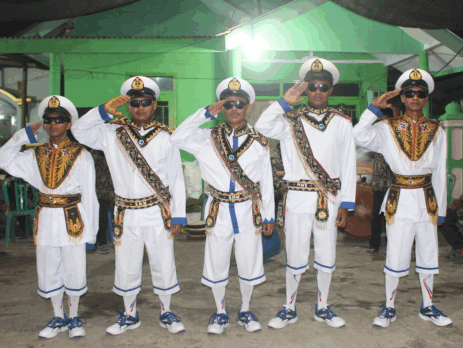
Dance in Glipang Rodhat art functions as the main actor. In terms of movement, the dance in Glipang Rodhat art contains elements of martial arts and soldiering movements which are presented in several movements, including: (1) opening salute, which is a respectful gesture like a war soldier (police / army) addressed to those who have a desire and the audience who are watching (2) offering, which is a bowing movement with the position of the body towards the right and left (3) seblakan, which is a movement taken from the movements of kanuragan science (4) silat, which takes from the movements of silat which in its presentation is presented in the Glipang Rodhat dance.(4) silat, which takes from the movements of silat which in its presentation is repeated several times (5) keprajuritan, which is in the form of marching movements that are presented improperly or not like the correct lines in general (6) nggegem, which is a movement of clenching the fist then lifting it and continuing to cover the ears with open palms.
Glipang Rodhat dance is substantially a form of representation of “something”. Symbolic movements include: (1) please visit as a depiction of people who always practice kanuragan (2) silat as a depiction of the persistence of people who are always prepared to fight the invaders (3) nggegem as a symbol of fighting spirit, independence, as well as a message to the audience to eliminate the characteristics of the colonizers (4) soldiering in the form of marching movements that are presented unlike the correct lines, is a form of satire and harassment or mockery of the colonizers.

Behind the word Simple
Glipang Rodhat art is a very simple traditional art form that reflects the simple life of the community. However, when viewed from various aspects contained in it, it has Islamic values, it can be seen from the symbols of the instruments used as well as songs and parikan which are full of useful advice in people's lives.
Glipang Rodhat art, like other traditional arts, is mostly a simple form of performance art. But behind the seemingly simple art, there are spiritual values and meaning. For this reason, it is suggested that the younger generation and related parties should look at, observe, or research traditional arts not only looking at various aspects that are explicit, but much more important is the implied meaning behind the art phenomenon. Until then, try to care, protect, and preserve it.
Author: Denny Bhagus Syahroni
Email: realbhagus@gmail.com
Library
Hariyati, M. 2016. “Glipang Rodhat Dance in Jarit Village, Candipuro District, Lumajang Regency”. APRON Journal of Performing Arts Thought, Vol. 1, No.9.
Sutarto, Ayu “A Glimpse of Pandhalungan Society”, paper delivered at the 2006 Cultural Exploration briefing organized by the Yogyakarta Center for Historical and Traditional Values Studies, August 7-10, 2006, https://kebudayaan.kemdikbud.go.id/bpnbyogyakarta/sekilas-tentang-masyarakat-pandhalungan/
Wuryansari, E. Th. and Ernawati Purwaningsih. 2017. Glipang Lumajang Art (Performance Form and Existence of Bintang Budaya Group). Yogyakarta: Cultural Value Preservation Center (BPNB).
Amin Supriyatin, 41, dance artist, cultural arts teacher at SMPN 1 Kunir, Suwandak street, Ngadinem alley, Ditotrunan village, Lumajang sub-district, Lumajang district.