By: Satrio Bogie Syamsudin
Building Relationships between Two Cultures
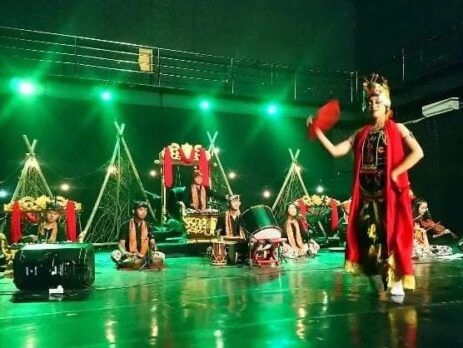
ETHNOMUSICOLOGY. Hangsun Gandrung brings the art of coastal Banyuwangi into the Surakarta area. The group attempts to adapt to the musical culture in Surakarta, reproducing the culture it brought from Banyuwangi into a different time and space. In terms of musical culture, the two regions have different backgrounds, so the Hangsun Gandrung group tries to build relationships with these differences.
The meeting of two different cultures creates intercultural contact. This is the background for the Hangsun Gandrung group to respond creatively to the contact between the two cultures. Shin Nakagawa quotes Margaret Kartomi's opinion on cultural encounters, that the process of cultural change has six forms, one of which is coexisting musical pluralism. Cultural pluralism usually occurs in urbanized societies where members of the community bi- (two) or multiethnic. Two possibilities can occur in music, one is to mix existing musical elements into a new synthesis and the other is for each to coexist. (Nakagawa, 2000). The cultural meeting of Banyuwangi arts presented in Surakarta is in line with Margaret Kartomi's opinion, so in this case the Hangsun Gandrung group tries to live and coexist by mixing elements of the musical idioms it creates.
This paper is based on previous research with the same title. The research method I used was descriptive qualitative with an ethnomusicological approach. The ethnomusicological approach implies the study of text and context. Text is a musical phenomenon, meaning that various things related to musical aspects become the object of study, while context is another text that surrounds it, in this case the discussion of contexts that are still closely related to music is the process of reproduction of Banyuwangi art in Surakarta. I use Pierre Bourdieu's concept of cultural reproduction to examine this.
Cultural Reproduction
The concept of cultural reproduction according to Bourdieu, explained that the process of cultural reproduction is inseparable from the concepts of habitus, capital, and domain, Bourdieu has a formula (Habitus x Capital) + Arena = Practice. (Krisdinanto, March 2014) The formula becomes the basic conceptual foundation to analyze how the cultural reproduction process of the Hangsun Gandrung group in Surakarta.
The concepts of habitus, capital, and arena then produce practices, which are carried out by actors or agents. The study of sociology is inseparable from the presence of humans, so that in the process of cultural reproduction the main character who runs is a human being called an actor or agent of cultural reproduction. Habitus is formed as well as forming a structure (actor or agent), which is a person's habit resulting from social relations. A brief explanation of habitus in the context of this paper can be concluded that Banyuwangi art performed in Surakarta is a form of embodiment of the concept of habitus. The musical experiences or habits of the members of the Hangsun Gandrung group when living in East Java, especially the arts in Banyuwangi, are presented in space and time in Surakarta.
Capital and Arena
The concept of capital according to Bourdie is divided into four types, namely: cultural capital, symbolic capital, social capital, and economic capital. (Nukha, April 2017). First, cultural capital is formed in each person by looking at their cultural background. The cultural capital owned by Hangsun Gandrung individually is in the form of musical education background and also the personal musical experience of each member. The presence of members from Banyuwangi further strengthens Hangsun Gandrung's musical power to introduce Banyuwang art in Surakarta. Merak Badra Waharuyung as the founder, composer, and manager of Hangsun Gandrung is actually not from Banyuwangi. Badra's musical experience comes from his musical education at ISI Surakarta. Badra also has experience in nyantrik in one of the art studios in Banyuwangi, thus gaining a basic knowledge of karawitan. Banyuwangen.
Hangsun Gandrung has social capital in the form of social networks built in Surakarta and surrounding areas, the added value is that Hangsun Gandrung has strong solidarity between its members. The majority of Hangsun Gandrung members are students of ISI Surakarta, so the interaction to communicate with each other is quite well maintained. When one of the departments at ISI Surakarta has an event related to karawitan or dance, the name Hangsun Gandrung is recommended to fill the event. One of the most recent events he has participated in is Swara Panghujung 2021 at the Central Java Cultural Park organized by the Department of Ethnomusicology at ISI Surakarta.
The symbolic capital referred to in this paper is the experience of performing Hangsun Gandrung in Surakarta. The existence of Hangsun Gandrung is not that big in Surakarta, considering that people in Surakarta tend to have their own views on foreign arts that are present in Surakarta. It is not about ethnocentrism, but rather the background of Banyuwangi art which is identical to fast and hard, then faced with the culture of art in Surakarta which has a subtle nature and has a strong character. pakem It has its own distinctive style of art, especially in music and dance.
Hangsun Gandrung must survive by seeking economic capital to be able to maintain its existence and creative process in Surakarta. I divide economic capital in this context into external and internal. External income means financial income that comes from outside such as gamelan and costume rentals. Basically, external income is unstable, this is based on the low interest of artists in Surakarta in using Banyuwangi gamelan in the art process. On the other hand, Hangsun Gandrung tries to maximize the rental of dance costumes, considering the enthusiasm of artists, students, and the public in Surakarta for the dance. Banyuwangen quite large. Internal income comes from monthly membership fees of Rp 20,000, which is used as an operational fund, such as room rental at Wisma Seni Taman Budaya Central Java, monthly electricity, equipment needs and other needs.
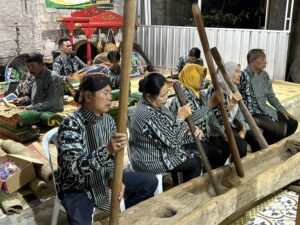
The field or arena referred to by Bourdiue is a place used in supporting a cultural reproduction, or referred to as an arena for cultural actors, Pendapa Wisma Seni Taman Budaya Jawa Tengah in Surakarta becomes one of the arenas for Hangsun Gandrung in its activities to reproduce Banyuwangi culture in Surakarta. The arena becomes a place for the Hangsun Gandrung group to practice regularly, such as practicing karawitan, kuntulan, and also Banyuwangi dances.
Negotiating with Time and Space
The life experiences and habits of the members of the Hangsun Gandrung group who come from various regions in East Java, in the context of time and space, also color their lives in Surakarta. They have strong cultural capital, both in terms of formal and non-formal education in the arts. In addition, through the social communication they build, their social capital is no longer in doubt. To survive, Hangsun Gandrung provides rental services for gamelan instruments and Banyuwangi dance costumes. So, from an economic point of view, this group can survive despite being overseas.
The symbolic capital that can be seen from the Hangsun Gandrung group, in every performance, always uses Banyuwangi symbols, both in terms of musical instruments, costumes, and musical idioms. Regarding the domain, the Hangsun Gandrung group that lives in a different domain can be accepted. This is also due to the openness of the people who can accept other cultures from various regions. Thus, it can be concluded that there is an assertion made by Hangsun Gandrung by presenting Banyuwangi art in Surakarta, which can then be aligned and recognized as other art communities that live and develop in Surakarta, Central Java.
In the life of the wider community, in order to be recognized in the new realm, one must have habitus and capital. Meanwhile, the owner community is expected to have the idea of openness to the culture present in their area. Linkages in social life so that they can maintain good social relations with each other, especially in the realm of art in Indonesia, which has quite an interesting cultural diversity.
Library
Abdullah, I. (2009). Cultural Construction and Reproduction. Yogyakarta: Student Library.
Endraswara, S. (2006). Cultural Research Methods, Theories, Techniques: Ideology, Epistemology, and Applications. Yogyakarta: Widyatama Library.
Gustami, S. (2000). A Comparative Study of Yogya-Solo Art Styles. Yogyakarta: Yayasan Untuk Indonesia.
Koentjaraningrat. (2009). Introduction to Anthropology Revised Edition. Jakarta: Rineka Cipta.
Krisdinanto, N. (March 2014). Pierre Bourdieu, the Peacemaker. KANAL Journal. Vol.2, No.2, 189-206.
Mursidi, A. (April 2018). Gandrung Performance Art in Banyuwangi. Santhet Journal, Volume 2, Number 1.
Nakagawa, S. (2000). Music and Cosmos. Jakarta: The Obor Foundation.
Nukha, R. (April 2017). Cultural Reproduction in Traditional Arts Performance at Soedjatmoko Hall. Journal of Sociological Analysis, 42-54.
Stone, R. M. (2008). Theory for Ethnomusicology. New York: Routledge
.
Author: Satrio Bogie Syamsudin
Ig: satriobogie
Email: satriobogie@gmail.com
Cover: ig hangsun_gandrung