By: Agim Gunawan
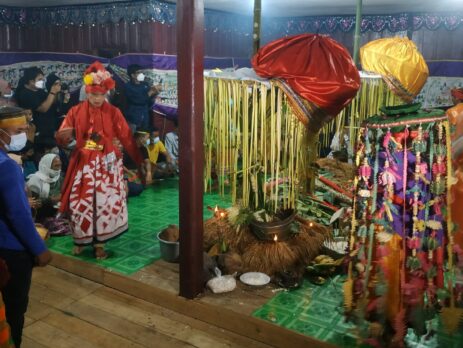
Ethnomusicology- Genrang palili’ is a musical ensemble that has an important role in traditional rituals. Mappalili’ in Bontomate'ne Village, Segeri Subdistrict, Pangkaje'ne and Islands Regency, South Sulawesi. This ritual concerns the safety and prosperity of the Bontomate'ne community, especially to avoid diseases, disasters, and pest interference in terms of agriculture. Mappalili’ is a traditional ritual carried out by the people of Bontomate'ne, with the aim of parading royal tools around the village, in this case is rakkala (plow tool). As time went by, there were changes that occurred in the Mappalili’, The changes are divided into external factors, which are changes that occur due to the entry of technology and globalization, and internal factors, which are changes due to the owner of the culture itself. These changes are divided into external factors, namely changes that occur due to the entry of technology and globalization into society, and internal factors, namely changes due to the owner of the culture itself.
Customary Rituals Mappalili’
Traditional arts are generally full of meaning and noble values of the nation's culture. Traditional arts are believed by the community not only as entertainment that creates excitement, but can also be a medium that can facilitate the prayers and hopes of the local community. The presentation of traditional arts is currently undergoing changes in various styles and variations, but functionally it is a form of adaptive strategy of the supporting community in maintaining and preserving traditional arts (Maladi, 2017: 90). In the Segeri area, there is a local culture that still exists in the midst of the rapid development of the times, namely traditional rituals. Mappalili’ .
Mappalili’ is a traditional ritual carried out by the people of Bontomate'ne, Segeri Subdistrict, Pangkaje'ne and Islands Regency, South Sulawesi, with the aim of parading royal tools around the village, in this case it is rakkala (plow tool). People in Segeri believe that without the ceremony Mappalili’, If the ceremony is not performed, then everything that will be hoped for will be lost. Therefore, the ceremony Mappalili’ needs to be organized every year when the community will start planting rice.

Although the majority are Muslims, people in Segeri still believe in animism. As in arajang, The local community believes that there is a god who inhabits the plow tool, so a ritual ceremony is needed as a means to honor the god who resides in the plow tool. arajang. Arajang are the tools of the kingdom owned by the community Bissu, It is a religion that is respected by the Segeri people who believe in it. Respectively Bissu in Segeri Sub-district, has arajang on its own. In general, arajang owned by the Bissu, In the form of krises, rocks, dried fruit seeds, and so on (Syaifullah, et al., 2021: 29).
Sounds found in traditional rituals Mappalili’ is an ensemble genrang palili’, which consists of musical instruments genrang, pui’-pui’, lae-lae, and the gong. The ensemble is led by Sakka, the gong player. The dances contained in Mappalili’, namely dance alosu and dance ma'bissu presented by the Bissu.
Changes in Mappalili’
Culture has a dynamic nature, which means that it always changes over time. Even so, the changes in question do not have to occur significantly. There are several factors that influence cultural change. According to Alvin Boskoff regarding the theory of social change, external and internal factors occur (Boskoff, 1964: 141-154).
From Alvin Boskoff's theory, it is explained that external stimuli are stimuli caused by the influx of technology and globalization into the community, so that the cultural values that have existed in the community since centuries ago have gradually faded, resulting in changes in function and changes in the form of culture. As for internal stimuli, it is explained that internal stimuli are stimuli that come from individuals or themselves.
External factors of change in traditional rituals Mappalili’, These include the government, as well as religion and belief. The government is one of the factors in reducing the presentation time of traditional rituals Mappalili’. Customary rituals Mappalili’ in ancient times was organized by the royal party and led directly by Puang Matoa. Therefore, traditional rituals Mappalili’ up to 40 days and 40 nights, as funding was borne by the King of Segeri, the nobility and traders. However, the implementation of Mappalili’ starting from 1968 until now it has been taken over by the government, in this case the Segeri Sub-District Head. Implementation Mappalili’ From time to time, the presentation time has decreased from 7 days and 7 nights, until now it is 3 days and 2 nights. The influence of religion and belief is the presence of Islam in the Segeri community, making the local community today, believe in Allah SWT. as God Almighty, so that belief in Dewata SeuwaE (local beliefs) that some local people believe in, have started to diminish.
Internal factors of change in traditional rituals Mappalili’, including the perpetrators of traditional rituals Mappalili’, presentation procession Mappalili’, and musical instruments. Performers of traditional rituals Mappalili’, in this case is pa'genrang palili’, The role of the musicians is to accompany the procession in the traditional ritual. Each music player has its own drumming pattern, such as in the player genrang and gong. Then, each player pui’-pui’ has a certain melodic pattern, so it is possible for changes to occur in the presentation of the ensemble. genrang palili’. The second internal factor is the reduction of the procession in Mappalili’. Procession mattena sanro which in previous studies were still presented, in Mappalili’ 2021 is no longer presented. This is still related to the reduction in presentation time on external factors. Then, the third internal factor is the change and reduction of musical instruments in the ensemble. genrang palili’. Genrang used in previous studies, still using genrang pa'bissu which is brown in color. But nowadays, it uses ganrang Makassar's distinctive red color. Then, the musical instrument ana’ baccing and buttons is no longer visible on Mappalili’ 2021, because the musical instrument was lost.

Future Expectations
Changes that occur in traditional rituals Mappalili’, The role of the government and the people of Bontomate'ne as the owners of the culture is inseparable. Some obstacles related to ritual funding Mappalili’, Bissu, and musicians, it would be good to pay more attention.
The sub-district head as a government agency, it would be nice to create a forum to foster and accommodate the aspirations of local artists in Segeri. This is proposed in order to minimize the changes that occur between the local government and the artists, especially in traditional rituals. Mappalili’. With this forum, it is hoped that the government can coordinate with the artists, so that mistakes that often occur do not recur. A suggestion that can be rethought is to create an inventory program.
Musicians who look elderly should be regenerated with local youth. This is so that the musicians in the ceremony Mappalili’ can be preserved, as well as creating a good regeneration. The problem of rhythmic patterns played in the genrang palili’ can be resolved with the knowledge shared with prospective successors of the musician. Mappalili’.
Library
Syaifullah, Ramli and Sawedi. 2021. “Bissu Identity in the midst of Modernity in Bontomatene Village, Segeri District, Pangkep Regency”, in Hasanuddin Journal of Sociology, Vol. III/I: 23-33.
Maladi, Agus. 2017. “Traditional Arts as a Means of Cultural Strategy”, in NUSA: Journal of Language and Literature, Vol. XII/I: 90-100.
Boskoff, Alvin. 1964. “Recent Theories of Social Change” in Werner J. Cahman and Alvin Boskoff, eds, Sociology and History: Theory and Research. London: The Free Press of Glencoe.
Author: Agim Gunawan
Advisors: Amir Razak, S.Sn., M.Hum. and Dra. Ela Yulaeliah, M.Hum.
Editor: Ribeth Nurvijayanto
Email : agimgnwn@gmail.com
Instagram : @agimgunawan